🌅 Early Life & Mysterious Origins
Neem Karoli Baba was born around the year 1900 (some accounts place it earlier, around 1895) in the village of Akbarpur in Firozabad district of Uttar Pradesh. His birth name was Lakshman Narayan Sharma, and he was born into a Brahmin family of modest means.
Even as a child, there were signs that this was no ordinary soul. He showed deep compassion for animals and the poor, often giving away food and belongings despite his family's modest situation. He had a natural inclination toward meditation, solitude, and spiritual matters.
At a very young age — some say as young as 11 — he was married as was customary in those times. However, the call of the divine was stronger than worldly ties. He soon renounced householder life and began his life as a wandering sadhu.
🚶 The Years of Wandering
For decades, Maharajji wandered across North India — through the jungles, villages, and towns of Uttar Pradesh, Rajasthan, Gujarat, and the Himalayan foothills. He lived as a true renunciant — no possessions, no fixed abode, dependent entirely on grace. During this period he was known by many names in different places: Tikonia Wale Baba, Handi Wale Baba, Chamatkari Baba.
He spent extended periods in deep meditation, sometimes in caves, sometimes beneath trees, sometimes in small temples. Wherever he went, miraculous occurrences followed him — healings, foreknowledge of future events, and the spontaneous transformation of whoever came into his presence.
🚂 The Train Miracle — How He Got His Name
Perhaps the most famous story of how he received his name "Neem Karoli Baba" involves a train journey. One day, he was travelling on a train when a ticket checker (TT) found him without a ticket. Despite his protestations of poverty, the checker ordered him off the train at Neem Karoli (Neeb Karori) station in Farrukhabad district, UP.
After he was removed from the train, the train refused to move. The engine refused to start. After attempts to restart it failed for some time, the station master and other passengers urged the TC to bring the baba back. Only when Maharajji re-boarded did the train start again.
This event created such a deep impression that the area and the baba became associated. He is said to have thereafter agreed to stay and build a temple in that village — and from then on became known as "Neem Karoli Baba," the saint of Neem Karoli.
🏔️ Kainchi Dham — The Heart of Grace
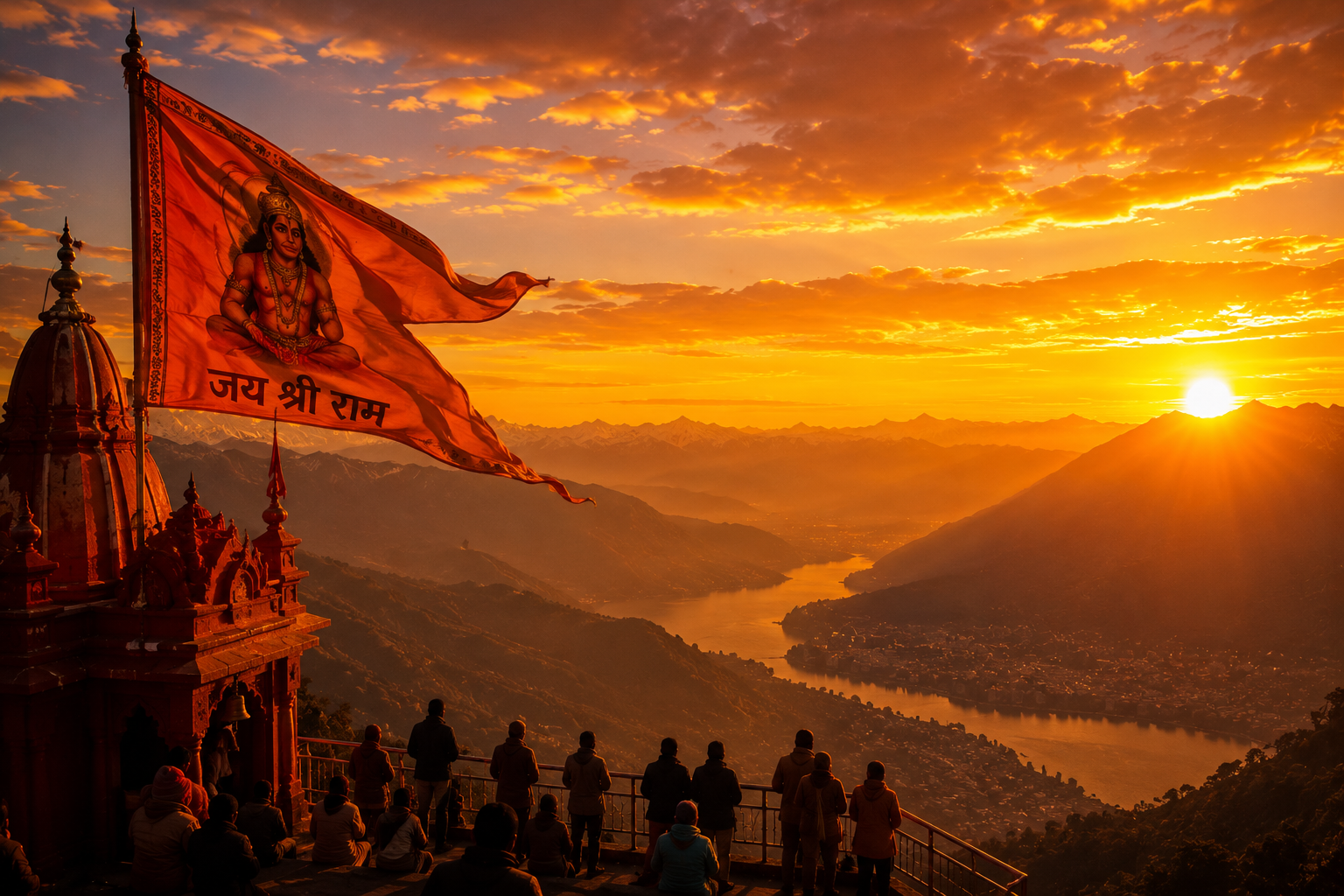
On June 15, 1964, Maharajji established Kainchi Dham — which would become his most important and beloved ashram. The name comes from the "kainchi" (scissor) shape formed by the two Himalayan streams that meet there near Bhowali in Nainital district, Uttarakhand.
Nestled in a valley surrounded by forested hills, Kainchi has an extraordinary spiritual atmosphere. Maharajji spent much of his later years here. The main Hanuman temple at Kainchi, consecrated in 1973, is considered especially powerful.
Every year on June 15 (the founding anniversary), a massive Bhandara (community feast) is held at Kainchi, drawing over 50,000–100,000 pilgrims. Even today, decades after Maharajji's mahasamadhi, the ashram remains vibrant with seekers from India and across the world.
🌍 Western Devotees — Grace Without Borders
In the late 1960s and early 1970s, a wave of young Westerners came to India seeking spiritual truth. Among them was Harvard professor Richard Alpert, who had come with Timothy Leary's LSD experiments and was deeply seeking something more authentic.
When Alpert met Maharajji, his life was utterly transformed. Maharajji renamed him Ram Dass ("servant of God") and sent him back to the West to share the message of love and service. Ram Dass's 1971 book "Be Here Now" — written from his experience with Maharajji — became one of the most influential spiritual books of the 20th century and brought thousands more to Maharajji's feet.
Other notable Western devotees include Krishna Das (Grammy-nominated kirtan singer), Jai Uttal (world musician), Dr. Larry Brilliant (who led the WHO's smallpox eradication in India), and many others whose lives were completely redirected by a single encounter with Maharajji.
🕯️ Mahasamadhi — September 11, 1973
On September 11, 1973, at approximately 1:15 AM, Neem Karoli Baba attained Mahasamadhi at the Jaipuria Hospital in Vrindavan, Uttar Pradesh. He was approximately 73 years old.
Those who were present reported that Maharajji had known the hour of his passing in advance and had been preparing his devotees — though his grace-filled presence made it difficult for anyone to truly accept it. He had been unwell for some days but refused conventional medical attention until it was too late.
His body was interred at Vrindavan, and a samadhi mandir was built. However, Maharajji's grace did not depart with his physical body. Devotees around the world continue to report his presence, visions, and miraculous interventions — making it clear that for a true saint, death is merely a change of form.
🌟 Enduring Legacy
Maharajji's legacy is vast and growing. His ashrams continue to operate across India — Kainchi Dham, Vrindavan, Lucknow, Hanuman Garhi (Nainital), Bhumiadhar, Kakrighat, and more. Internationally, the Neem Karoli Baba Ashram in Taos, New Mexico carries his presence to the West.
The Silicon Valley connection to Maharajji is well-documented: Steve Jobs visited Kainchi Dham in 1974 before founding Apple. Mark Zuckerberg visited in 2015 on the advice of Prime Minister Modi when he was going through a difficult period at Facebook. Both have attributed transformative insights to the visit.
Most of all, Maharajji lives in the hearts of millions of ordinary people — farmers, students, professionals, seekers — across India and the world, who have found in his love a refuge that transcends all divisions of religion, caste, nationality, and time.